 Add to Chrome
 Add to Firefox
 Add to Edge
SAM: State-Adaptive Memory for Long-Horizon Reasoning Agent
May 23, 2026
Long-horizon agentic reasoning requires large language models to act over long interaction histories containing thoughts, tool calls, observations, and partial conclusions. The challenge is not merely that these histories grow long, but that information needed for the current decision may be scattered across distant steps and only become relevant later. Existing approaches address this difficulty by truncating the interaction history, compressing it into shorter surrogates, or retrieving selected parts of it for reuse, but they do not explicitly model how access to past interaction should adapt to the agent's evolving state. We instead cast long-horizon reasoning as a problem of state-adaptive memory. To this end, we propose State-Adaptive Memory~(SAM), a standalone framework that consolidates ongoing interaction into compact memory cues while preserving raw trajectory pages for intent-driven recall. These cues are not treated as replacements for history; rather, they serve as lightweight handles that allow the agent to reconstruct temporally distant information according to its current needs, without retraining the underlying backbone. We further optimize the memory module through expert-guided supervision and reinforcement learning, aligning it with trajectory-level utility. Across BrowseComp, BrowseComp-ZH, WideSearch, and HLE, SAM consistently outperforms strong baselines over diverse agent backbones. Our results suggest that explicit memory modeling provides a simple and effective foundation for long-horizon agentic reasoning.

AgentFugue: Agent Scaling for Long-Horizon Tasks through Collective Reasoning
May 23, 2026Recent progress on long-horizon agentic tasks has been driven largely by scaling up individual agents through stronger models, better tools, and more effective scaffolding. In contrast, much less is understood about scaling out: whether multiple peer agents, all targeting the same task, can become an additional source of capability without relying on explicit role specialization or workflow orchestration. We study this question and propose AgentFugue, a collective reasoning framework built around a shared reasoning hub. As peer agents explore the same task in parallel, the hub records concise notes on what each agent has established, attempted, or ruled out, and enables each agent to selectively access what other agents have discovered in a form useful for its current search. This design turns otherwise isolated trajectories into a connected ecology of reusable intermediate reasoning without requiring centralized planning. We instantiate the hub as a plug-in communication layer, trained with supervised fine-tuning and end-to-end reinforcement learning. Across the challenging long-horizon settings we study, AgentFugue improves over strong baselines. Our results suggest that collective reasoning can turn scaling out peer agent systems into a distinct source of capability gains, rather than merely a way of spending more compute.
PlanningBench: Generating Scalable and Verifiable Planning Data for Evaluating and Training Large Language Models
May 20, 2026Planning is a fundamental capability for large language models (LLMs) because such complex tasks require models to coordinate goals, constraints, resources, and long-term consequences into executable and verifiable solutions. Existing planning benchmarks, however, usually treat planning data as fixed collections of instances rather than controllable generation targets. This limits scenario coverage, ties difficulty to surface-level proxies rather than structural sources, and offers limited support for scalable generation, automatic verification, or planning-oriented training. We introduce PlanningBench, a framework for generating scalable, diverse, and verifiable planning data for both evaluation and training. PlanningBench starts from real planning scenarios and abstracts practical workflows into a structured taxonomy of more than 30 task types, subtasks, constraint families, and difficulty factors. Guided by this taxonomy, a constraint-driven synthesis pipeline instantiates self-contained planning problems with adaptive difficulty control, quality filtering, and instance-level verification checklists. This shifts planning data construction from fixed benchmark collection to controllable generation while preserving realistic task grounding. We use PlanningBench to evaluate open-source and closed-source frontier LLMs, and find that current models still struggle to produce complete solutions under coupled constraints. Beyond evaluation, reinforcement learning on verified PlanningBench data improves performance on unseen planning benchmarks and broader instruction-following tasks. Further analysis suggests that determinate or well-specified optimal solutions provide clearer reward signals and more stable training dynamics. Overall, PlanningBench provides a controllable source of planning data for diagnosing and improving generalizable planning abilities in LLMs.
Laser: Governing Long-Horizon Agentic Search via Structured Protocol and Context Register
Dec 23, 2025Recent advances in Large Language Models (LLMs) and Large Reasoning Models (LRMs) have enabled agentic search systems that interleave multi-step reasoning with external tool use. However, existing frameworks largely rely on unstructured natural-language reasoning and accumulate raw intermediate traces in the context, which often leads to unstable reasoning trajectories, context overflow, and degraded performance on complex multi-hop queries. In this study, we introduce Laser, a general framework for stabilizing and scaling agentic search. Laser defines a symbolic action protocol that organizes agent behaviors into three spaces: planning, task-solving, and retrospection. Each action is specified with explicit semantics and a deterministic execution format, enabling structured and logical reasoning processes and reliable action parsing. This design makes intermediate decisions interpretable and traceable, enhancing explicit retrospection and fine-grained control over reasoning trajectories. In coordination with parsable actions, Laser further maintains a compact context register that stores only essential states of the reasoning process, allowing the agent to reason over long horizons without uncontrolled context expansion. Experiments on Qwen2.5/3-series models across challenging multi-hop QA datasets show that Laser consistently outperforms existing agentic search baselines under both prompting-only and fine-tuning settings, demonstrating that Laser provides a principled and effective foundation for robust, scalable agentic search.
Decoupled Geometric Parameterization and its Application in Deep Homography Estimation
May 22, 2025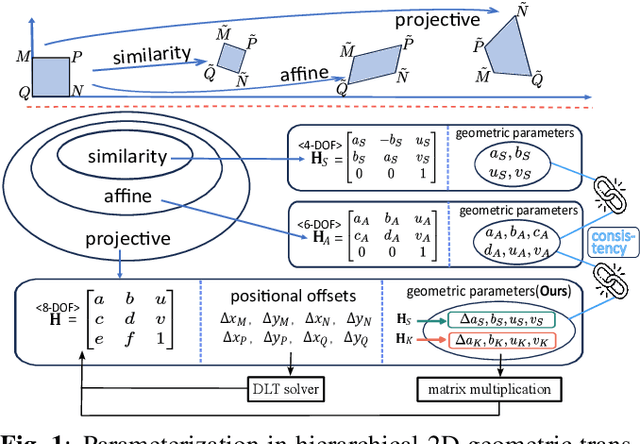
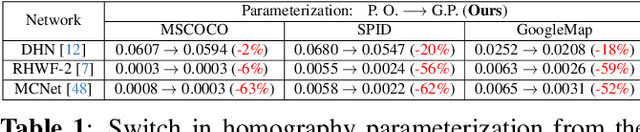
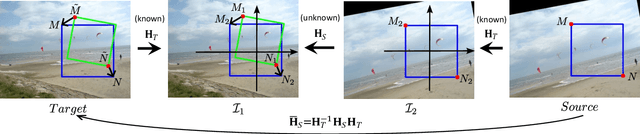
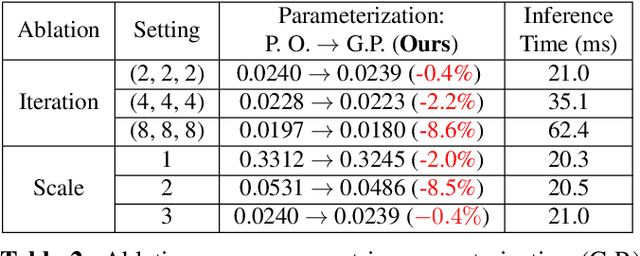
Planar homography, with eight degrees of freedom (DOFs), is fundamental in numerous computer vision tasks. While the positional offsets of four corners are widely adopted (especially in neural network predictions), this parameterization lacks geometric interpretability and typically requires solving a linear system to compute the homography matrix. This paper presents a novel geometric parameterization of homographies, leveraging the similarity-kernel-similarity (SKS) decomposition for projective transformations. Two independent sets of four geometric parameters are decoupled: one for a similarity transformation and the other for the kernel transformation. Additionally, the geometric interpretation linearly relating the four kernel transformation parameters to angular offsets is derived. Our proposed parameterization allows for direct homography estimation through matrix multiplication, eliminating the need for solving a linear system, and achieves performance comparable to the four-corner positional offsets in deep homography estimation.
OmniEval: An Omnidirectional and Automatic RAG Evaluation Benchmark in Financial Domain
Dec 17, 2024As a typical and practical application of Large Language Models (LLMs), Retrieval-Augmented Generation (RAG) techniques have gained extensive attention, particularly in vertical domains where LLMs may lack domain-specific knowledge. In this paper, we introduce an omnidirectional and automatic RAG benchmark, OmniEval, in the financial domain. Our benchmark is characterized by its multi-dimensional evaluation framework, including (1) a matrix-based RAG scenario evaluation system that categorizes queries into five task classes and 16 financial topics, leading to a structured assessment of diverse query scenarios; (2) a multi-dimensional evaluation data generation approach, which combines GPT-4-based automatic generation and human annotation, achieving an 87.47\% acceptance ratio in human evaluations on generated instances; (3) a multi-stage evaluation system that evaluates both retrieval and generation performance, result in a comprehensive evaluation on the RAG pipeline; and (4) robust evaluation metrics derived from rule-based and LLM-based ones, enhancing the reliability of assessments through manual annotations and supervised fine-tuning of an LLM evaluator. Our experiments demonstrate the comprehensiveness of OmniEval, which includes extensive test datasets and highlights the performance variations of RAG systems across diverse topics and tasks, revealing significant opportunities for RAG models to improve their capabilities in vertical domains. We open source the code of our benchmark in \href{https://github.com/RUC-NLPIR/OmniEval}{https://github.com/RUC-NLPIR/OmniEval}.
LLMs + Persona-Plug = Personalized LLMs
Sep 18, 2024
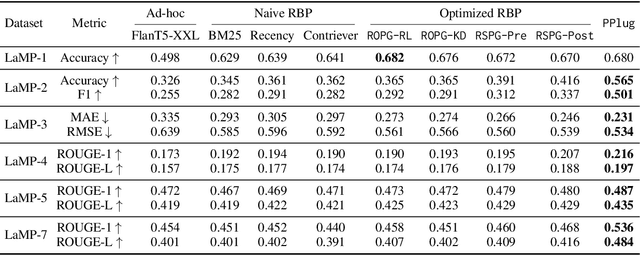


Personalization plays a critical role in numerous language tasks and applications, since users with the same requirements may prefer diverse outputs based on their individual interests. This has led to the development of various personalized approaches aimed at adapting large language models (LLMs) to generate customized outputs aligned with user preferences. Some of them involve fine-tuning a unique personalized LLM for each user, which is too expensive for widespread application. Alternative approaches introduce personalization information in a plug-and-play manner by retrieving the user's relevant historical texts as demonstrations. However, this retrieval-based strategy may break the continuity of the user history and fail to capture the user's overall styles and patterns, hence leading to sub-optimal performance. To address these challenges, we propose a novel personalized LLM model, \ours{}. It constructs a user-specific embedding for each individual by modeling all her historical contexts through a lightweight plug-in user embedder module. By attaching this embedding to the task input, LLMs can better understand and capture user habits and preferences, thereby producing more personalized outputs without tuning their own parameters. Extensive experiments on various tasks in the language model personalization (LaMP) benchmark demonstrate that the proposed model significantly outperforms existing personalized LLM approaches.
OmniGen: Unified Image Generation
Sep 17, 2024
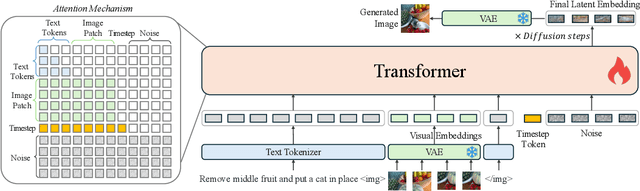
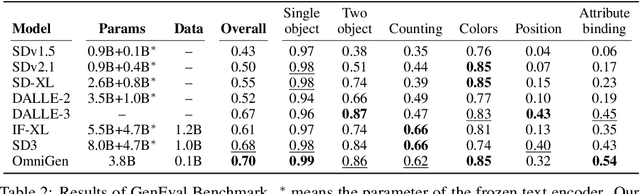
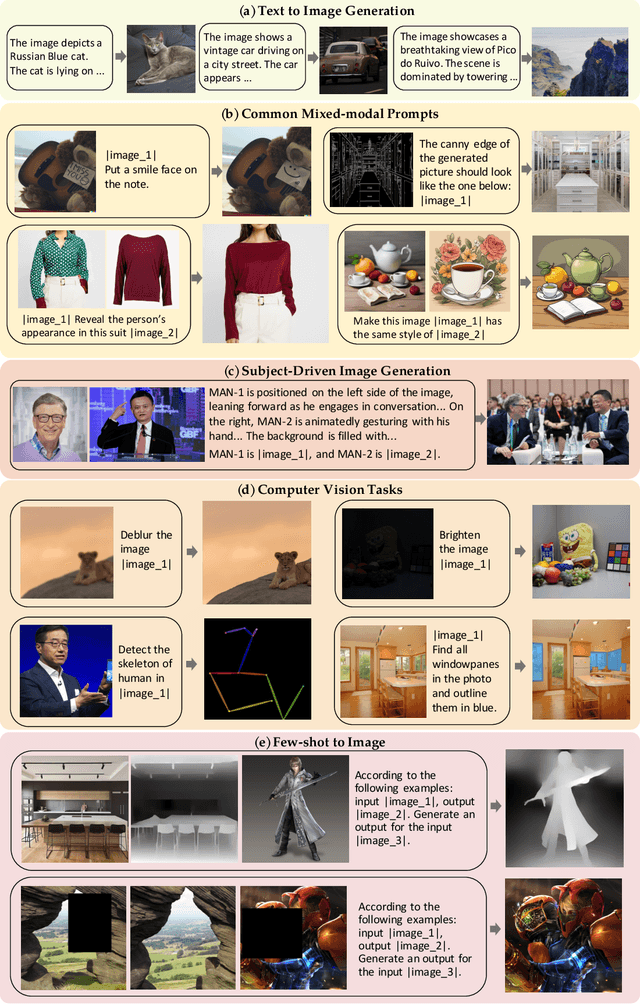
In this work, we introduce OmniGen, a new diffusion model for unified image generation. Unlike popular diffusion models (e.g., Stable Diffusion), OmniGen no longer requires additional modules such as ControlNet or IP-Adapter to process diverse control conditions. OmniGenis characterized by the following features: 1) Unification: OmniGen not only demonstrates text-to-image generation capabilities but also inherently supports other downstream tasks, such as image editing, subject-driven generation, and visual-conditional generation. Additionally, OmniGen can handle classical computer vision tasks by transforming them into image generation tasks, such as edge detection and human pose recognition. 2) Simplicity: The architecture of OmniGen is highly simplified, eliminating the need for additional text encoders. Moreover, it is more user-friendly compared to existing diffusion models, enabling complex tasks to be accomplished through instructions without the need for extra preprocessing steps (e.g., human pose estimation), thereby significantly simplifying the workflow of image generation. 3) Knowledge Transfer: Through learning in a unified format, OmniGen effectively transfers knowledge across different tasks, manages unseen tasks and domains, and exhibits novel capabilities. We also explore the model's reasoning capabilities and potential applications of chain-of-thought mechanism. This work represents the first attempt at a general-purpose image generation model, and there remain several unresolved issues. We will open-source the related resources at https://github.com/VectorSpaceLab/OmniGen to foster advancements in this field.
RichRAG: Crafting Rich Responses for Multi-faceted Queries in Retrieval-Augmented Generation
Jun 18, 2024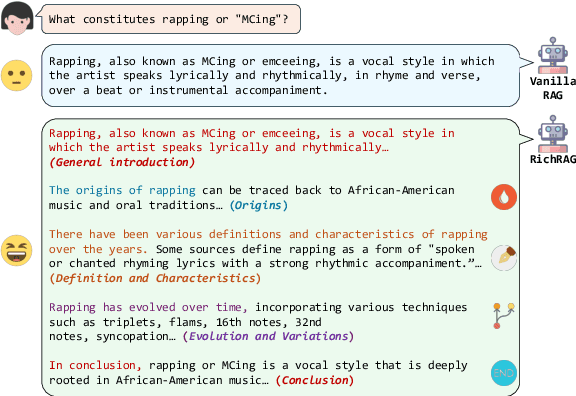
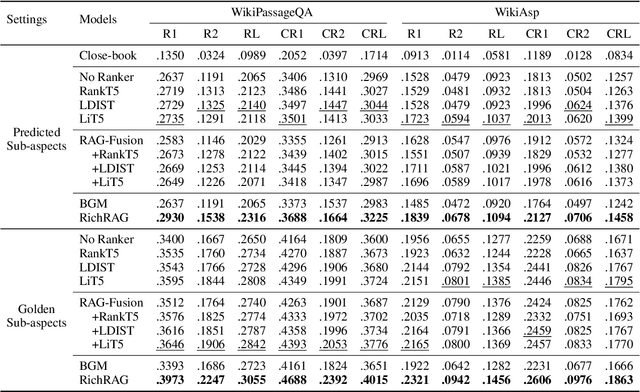
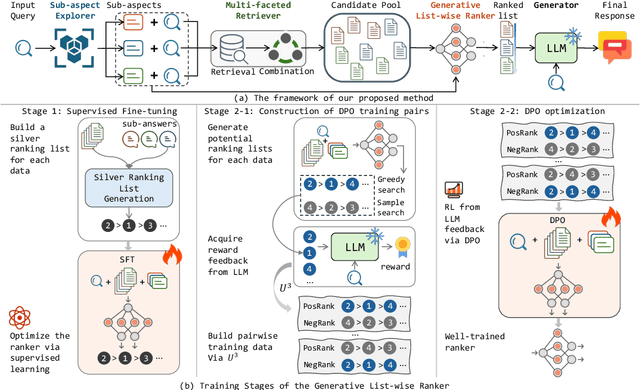
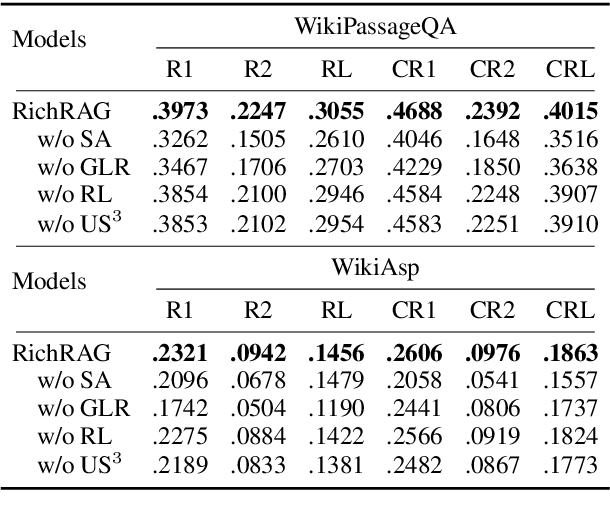
Retrieval-augmented generation (RAG) effectively addresses issues of static knowledge and hallucination in large language models. Existing studies mostly focus on question scenarios with clear user intents and concise answers. However, it is prevalent that users issue broad, open-ended queries with diverse sub-intents, for which they desire rich and long-form answers covering multiple relevant aspects. To tackle this important yet underexplored problem, we propose a novel RAG framework, namely RichRAG. It includes a sub-aspect explorer to identify potential sub-aspects of input questions, a multi-faceted retriever to build a candidate pool of diverse external documents related to these sub-aspects, and a generative list-wise ranker, which is a key module to provide the top-k most valuable documents for the final generator. These ranked documents sufficiently cover various query aspects and are aware of the generator's preferences, hence incentivizing it to produce rich and comprehensive responses for users. The training of our ranker involves a supervised fine-tuning stage to ensure the basic coverage of documents, and a reinforcement learning stage to align downstream LLM's preferences to the ranking of documents. Experimental results on two publicly available datasets prove that our framework effectively and efficiently provides comprehensive and satisfying responses to users.
DomainRAG: A Chinese Benchmark for Evaluating Domain-specific Retrieval-Augmented Generation
Jun 09, 2024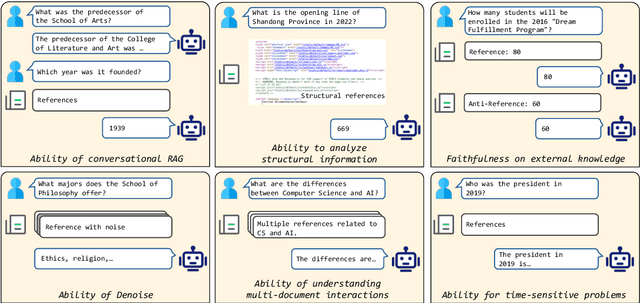
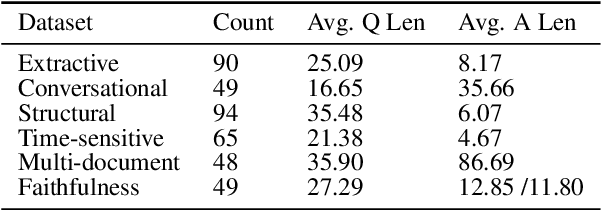
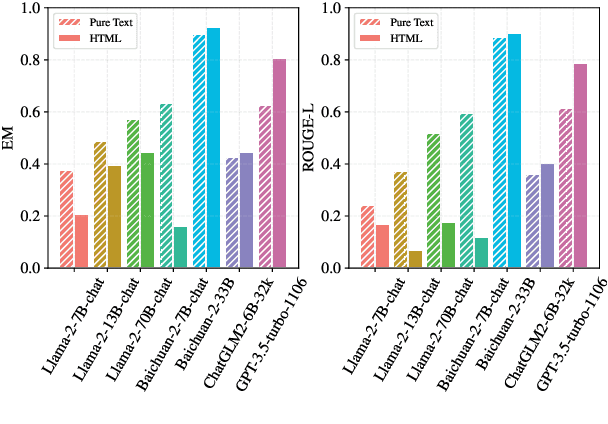
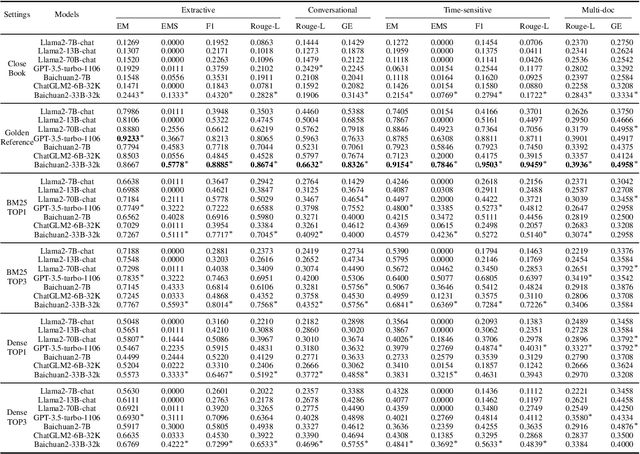
Retrieval-Augmented Generation (RAG) offers a promising solution to address various limitations of Large Language Models (LLMs), such as hallucination and difficulties in keeping up with real-time updates. This approach is particularly critical in expert and domain-specific applications where LLMs struggle to cover expert knowledge. Therefore, evaluating RAG models in such scenarios is crucial, yet current studies often rely on general knowledge sources like Wikipedia to assess the models' abilities in solving common-sense problems. In this paper, we evaluated LLMs by RAG settings in a domain-specific context, college enrollment. We identified six required abilities for RAG models, including the ability in conversational RAG, analyzing structural information, faithfulness to external knowledge, denoising, solving time-sensitive problems, and understanding multi-document interactions. Each ability has an associated dataset with shared corpora to evaluate the RAG models' performance. We evaluated popular LLMs such as Llama, Baichuan, ChatGLM, and GPT models. Experimental results indicate that existing closed-book LLMs struggle with domain-specific questions, highlighting the need for RAG models to solve expert problems. Moreover, there is room for RAG models to improve their abilities in comprehending conversational history, analyzing structural information, denoising, processing multi-document interactions, and faithfulness in expert knowledge. We expect future studies could solve these problems better.